Table of contents (6)
Two stained timber boards that look identical on a showroom rack can clash sharply once placed beside site flooring and room lighting. Daylight balance, luminaire spectrum, viewing angle, surface sheen, and the underlying wood species all interact to shape what your eyes perceive.
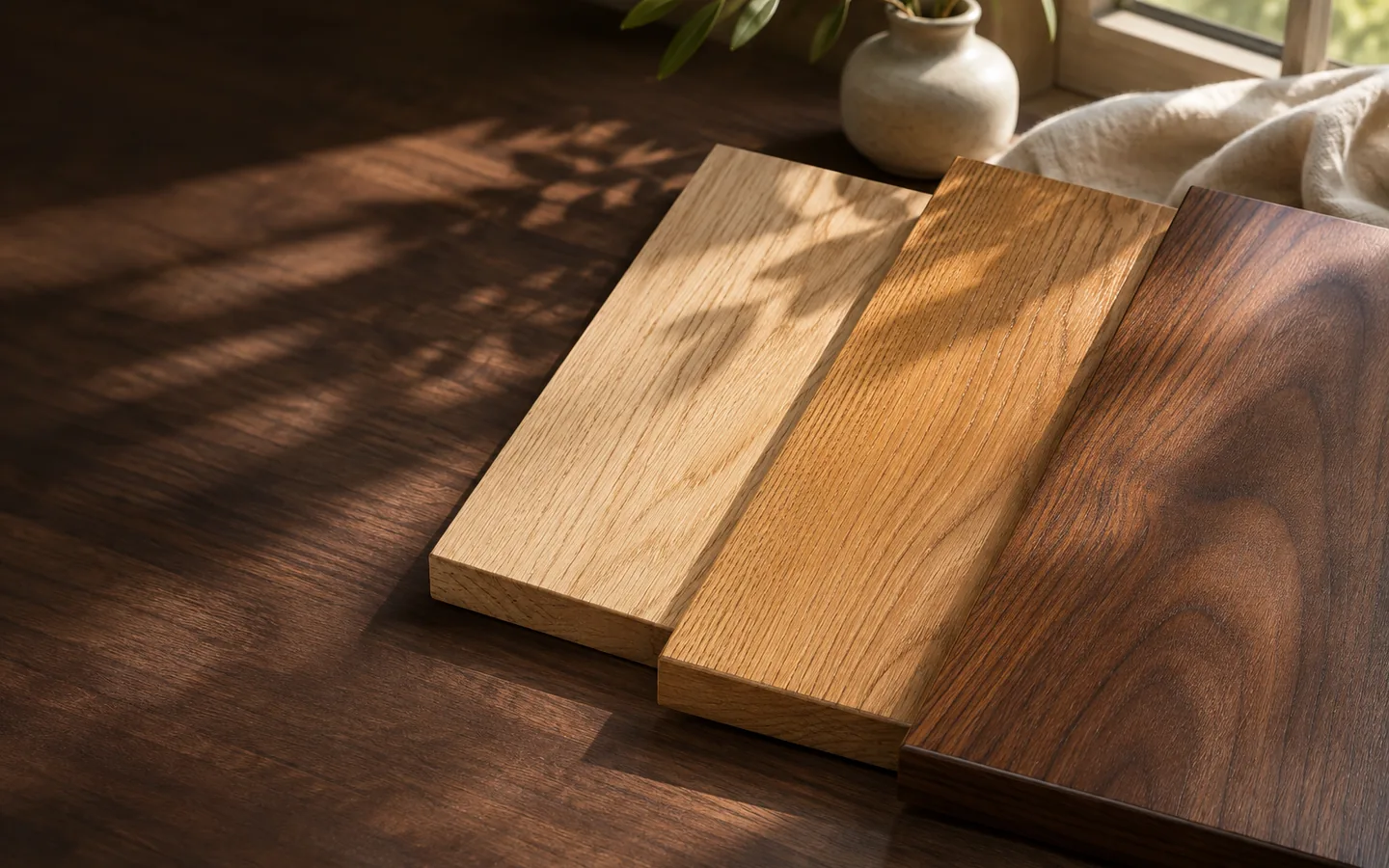
Never approve furniture colours from phone photographs or printed catalogues. Base every sign-off on a complete physical control sample finished with the full sealer, stain, and topcoat schedule proposed for production.
Inspect full-system samples in real orientation
A tiny colour chip barely shows natural grain movement, pore depth, or colour transitions across a 2,400 mm wardrobe bank or long dining table.
- Match installed orientation: Stand wardrobe or kitchen door samples upright at eye height and lay tabletop samples horizontally so light hits the grain realistically.
- Test on the true substrate: Identical stain mixes read noticeably warmer, cooler, or more porous depending on whether the core face is solid oak, sliced veneer, or ash.
- Compare beside room finishes: Lay the wood swatch directly against actual floor planks, stone benchtops, upholstery textiles, and painted drywall cards.
- Confirm veneer leaf matching: For natural wood veneers, specify whether doors require sequential slip matching, mirrored book matching, or planked effect before pressing.
Test under natural daylight and installed site lamps
Metamerism happens when two finish pieces appear matched under showroom spotlights yet drift into opposing warm and cool tones once installed under residential LEDs or northern daylight.
| Light Source / Surface Sheen | Visual Effect on Wood Tone | Practical Sign-Off Check |
|---|---|---|
| Natural daylight | Reveals true base pigments, pore contrast, and subtle undertones | Inspect both near sunny windows and inside shaded interior alcoves |
| Warm lamps (2700K – 3000K) | Pulls oak and walnut finishes toward richer amber and caramel warmth | Watch red-undertone timbers so they do not turn overly orange |
| Neutral lamps (4000K) | Balances crisp task visibility with natural timber character | Confirm luminaire Colour Rendering Index (CRI >= 90) so wood stays lifelike |
| Dead matte / low sheen | Diffuses harsh glare and highlights organic tactile grain | Tilt the sample 30–45° toward a lamp to inspect evenness without blotchy patches |
| Satin / Semi-gloss sheen | Deepens perceived stain richness while reflecting adjacent windows | View from an oblique standing angle to check glare near large glazing |
Even two lamps rated at the same 3000K colour temperature can render wood tones differently if their spectral output differs. Always verify control samples under the exact fixtures installed on site.
Document approved ranges and limit samples for production
Solid timber and real wood veneer naturally carry variations in tone and figure. Establishing clear visual boundaries during approval protects both client expectations and factory quality control.
- Label every control sample: Record substrate species, finish code, gloss/sheen rating, grain direction, approval date, and revision number directly on the sample back.
- Approve light & dark limit samples: Where wide natural colour variation exists, sign off a central target swatch alongside upper light and lower dark limit panels.
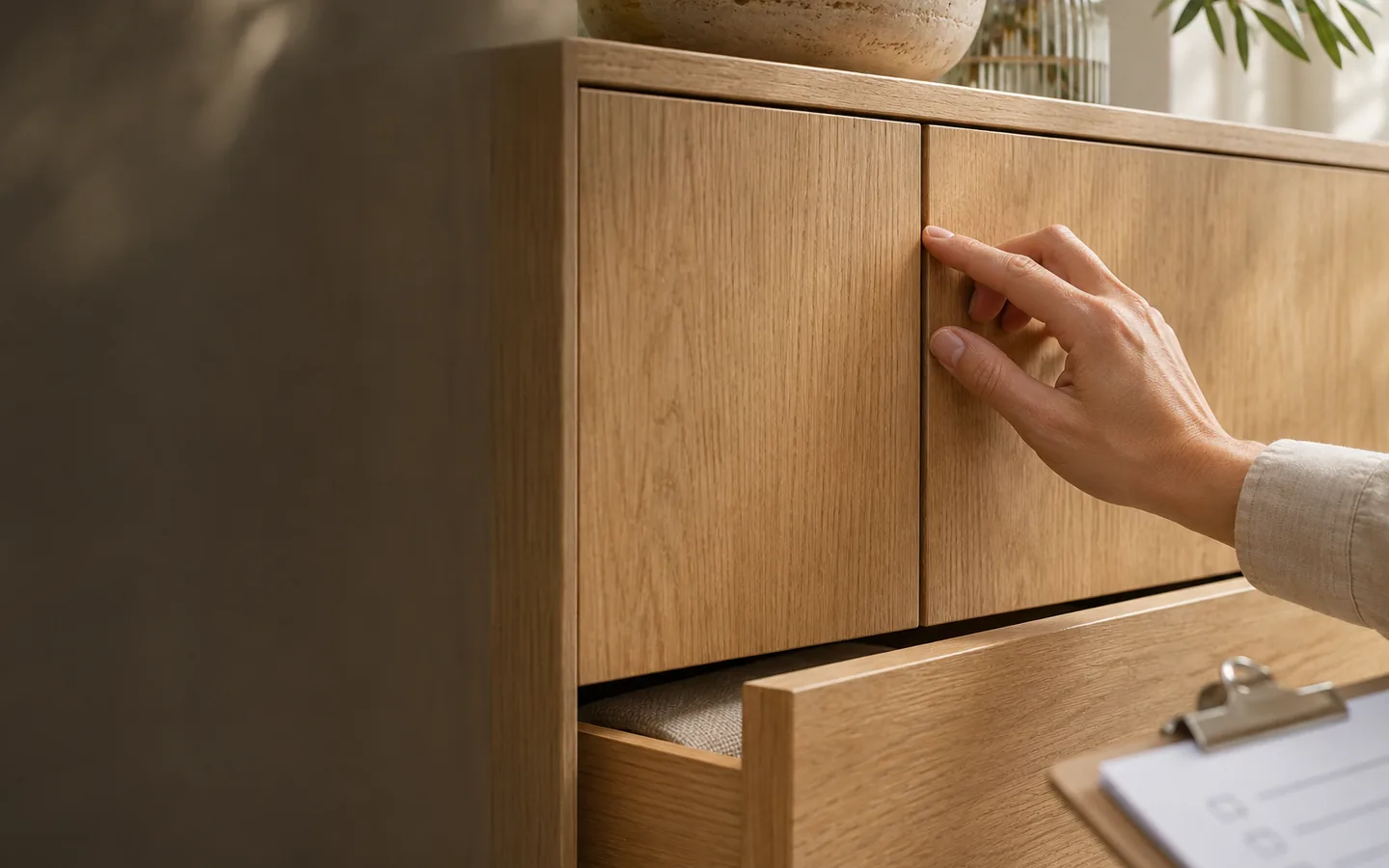
- Inspect grouped doors or first articles: On larger runs, review two or three adjacent doors or the first completed production piece under agreed site lighting before bulk finishing.
- Retain physical samples until handover: Keep photographs for documentation logs only; resolve handover colour checks strictly against signed physical control boards.
Frequently Asked Questions
Why does a wood finish photo sent from the factory look different from the physical piece?
Phone cameras apply automatic white balance and saturation adjustments, while backlit screens emit light rather than reflecting ambient room light. Physical samples evaluated in the target room remain essential for colour accuracy.
Will natural wood furniture change colour over the first few years?
Yes. Prolonged UV and daylight exposure gradually softens or warms certain natural species (for instance, American walnut may mellow slightly while oak warms). Specifying UV-inhibited topcoats and window shading near strong sunlight slows uneven tone shifts.
Further reading
- Plywood vs. MDF vs. Particleboard: Choosing the Right Cabinet Core
- Wood Furniture Handover Inspection Checklist: Specs, Finish, Function