Table of contents (7)
- 01 Inventory bulky objects and zone compartments by frequency
- 02 Calculate true net internal space after doors and hardware
- 03 Match opening mechanisms and hardware load ratings
- 04 Validate storage layouts on a first-article unit
- 05 Frequently Asked Questions
- 06 Further reading
- 07 Technical references
A storage wall can look crisp on architectural elevations and still frustrate people daily if deep shelves swallow small items at the back, adjustable pegs miss binder heights by 10 mm, or hinge arms clip inner pull-out drawers. Good storage design begins with the objects inside and the hand movements required to retrieve them.
Inventory bulky objects and zone compartments by frequency
Before dividing cabinet bays symmetrically, log the exact width, height, depth, and weight of items whose footprint cannot shrink—vacuum cleaners, luggage, stacked dinnerware, A4 archive boxes, or small kitchen appliances.
- Primary reach zone (600 – 1,600 mm height): Reserve eye-to-waist zones for daily clothing, everyday tableware, or active folders without awkward bending or reaching.
- Lower heavy zone (below 600 mm): Keep heavy cookware, bulk supplies, vacuums, and suitcases low—ideally on pull-out drawers rather than deep fixed floor shelves.
- Upper seasonal zone (above 1,700 mm): Store seasonal textiles, spare bedding, and infrequently accessed archives cleanly overhead.
- Zone by task point of use: Position drawers and small trays closest to where items are unpacked or operated daily.
Calculate true net internal space after doors and hardware
A common specification mistake is checking stored box lengths against an external 600 mm cabinet figure. Doors, front reveals, ventilated backs, and concealed runners consume usable internal space on all three axes.
Worked check: a 340 mm deep storage crate also needs finger grip clearance plus slight tilt room if an adjacent wall stops a hinged door from opening wide. Always verify net clear internal width, height, and depth with runners, hinges, and handle bolts installed.
Quick internal clear-sizing guide by category
| Stored Category | Net Internal Depth | Typical Height / Bay Clearances |
|---|---|---|
| Short shirts & tailored jackets on hangers | 540 – 580 mm (approx. 600 mm external) | 950 – 1,050 mm clear drop from hanging rod |
| Long coats and full-length dresses | 540 – 580 mm | 1,400 – 1,550 mm clear hanging drop |
| Folded knitwear and everyday garments | 380 – 450 mm | 280 – 340 mm vertical shelf spacing |
| Everyday footwear & tall boots | 320 – 360 mm | 160 – 200 mm per tier (340 mm for boots) |
| A4 lever-arch files & large hardcover books | 300 – 350 mm | 330 – 360 mm vertical clear opening |
Deep lower shelves turn into dark blind pockets over time. Below waist height and deeper than 500 mm, full-extension drawers deliver far more usable storage than fixed shelves.
Match opening mechanisms and hardware load ratings
Selecting the right hardware ensures users reach the rear third of every compartment comfortably for years:
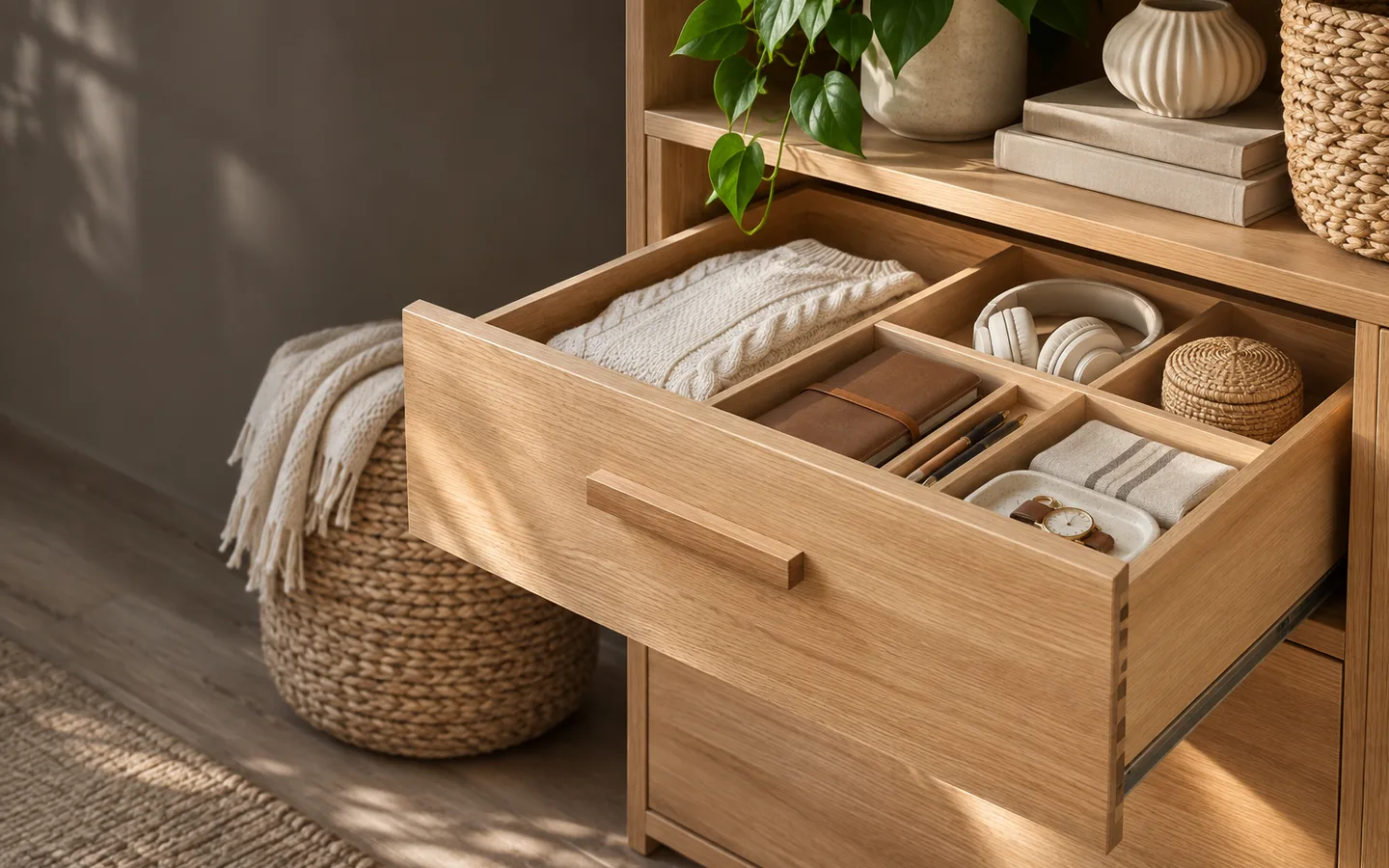
- Specify full-extension drawer runners: Full extension brings the back of the drawer clear of the carcase edge so small objects never hide behind dividers.
- Build in adjustable shelf peg lines: Multi-hole drilling lets homeowners or office managers adapt bay heights as storage needs evolve.
- Check zero-protrusion hinge geometry: When placing pull-out trays behind hinged doors, confirm the hinge arm clears the tray edge cleanly at the actual opening angle.
- Align shelf & runner load specs: Verify dynamic load capacities and fastening instructions for heavy drawer bays prior to approving shop drawings.
Validate storage layouts on a first-article unit
Prepare a room-by-room compartment schedule listing minimum clear dimensions, expected load, and hardware type for every bay. On multi-unit projects, place real storage boxes, hangers, or equipment inside the first installed sample cabinet and update drawings before releasing repeat batch manufacturing.
Frequently Asked Questions
Should a wardrobe be 550 mm or 600 mm external depth to prevent jacket sleeves catching?
Adult hangers typically span 420–450 mm, and padded coat shoulders require 530–550 mm net clear depth inside the carcase. Hinged wardrobes usually need around 580–600 mm external depth, while sliding-door wardrobes (whose twin tracks take 80–90 mm) should reach 630–650 mm overall.
What shelf span prevents sagging under heavy books or files?
With standard 18 mm engineered wood under heavy bound books or A4 files, keep unsupported shelf bays within 700–800 mm. Wider bays of 900–1,000 mm should step up to 25 mm thickness or incorporate intermediate dividers.
Further reading
- How to Measure for Custom and Fitted Furniture Before Ordering
- Plywood vs. MDF vs. Particleboard: Choosing the Right Cabinet Core