Table of contents (6)
A furniture quotation that simply reads “engineered wood cabinetry” leaves crucial engineering decisions unanswered. To compare competing bids fairly and prevent sagging shelves or swollen edges later, separate every cabinet into four functional parts: doors/drawer fronts, carcase panels, load-bearing shelves, and backs.
For each component, request a clear schedule detailing the exact board code, nominal thickness, face and back surfacing, edge treatment, and approved humidity conditions.
Compare core constructions: plywood, MDF, and particleboard
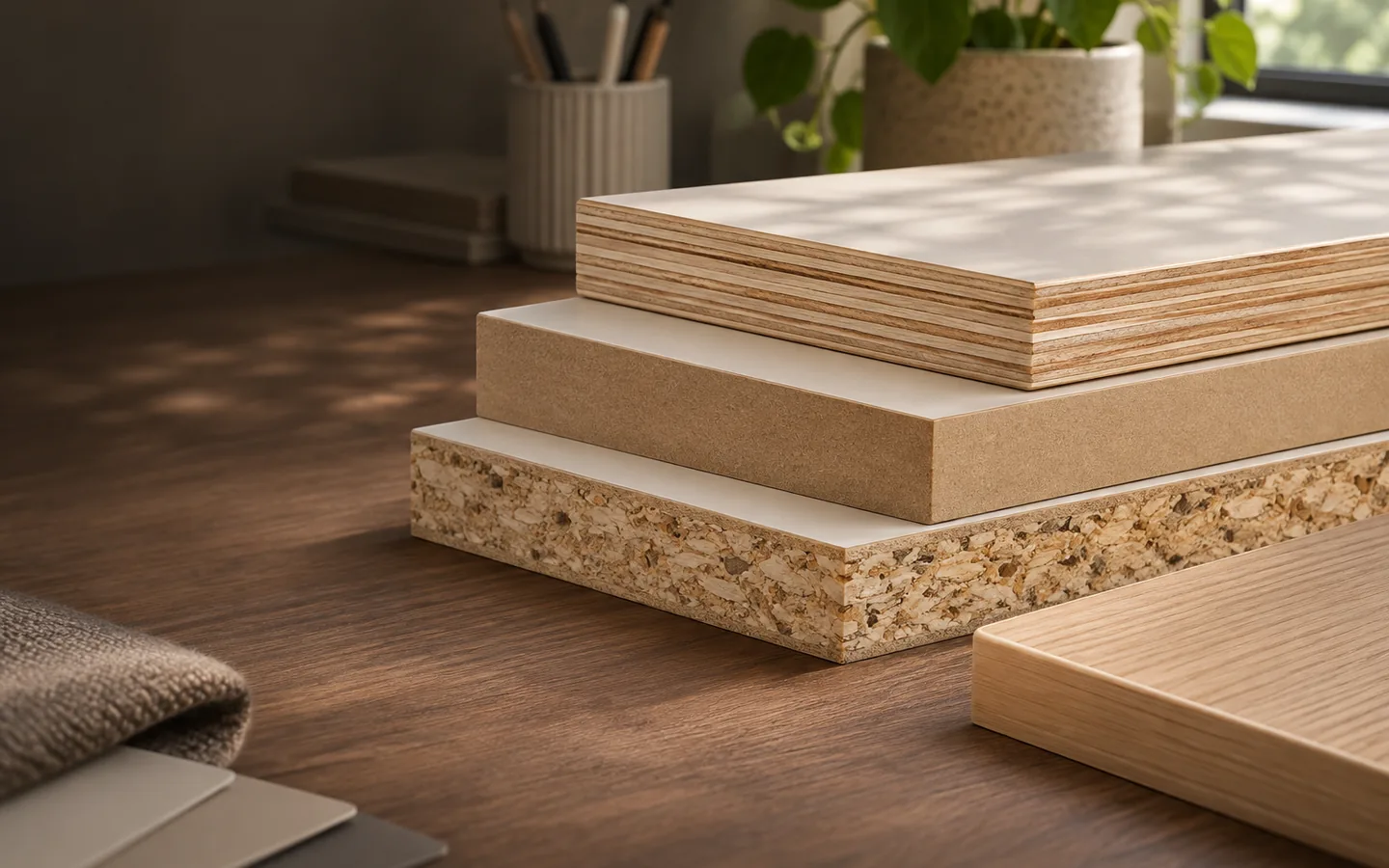
The three primary engineered panel cores behave very differently under screw withdrawal loads, CNC machining, and humidity shifts.
| Attribute | Plywood | MDF (Medium Density Fibreboard) | Particleboard / MFC |
|---|---|---|---|
| Core composition | Cross-laminated thin wood veneers bonded at alternating grain angles | Refined wood fibres consolidated with resin under heat and pressure | Graded wood chips and particles bonded with resin |
| Surface smoothness & routing | Good face finish; exposed layered edge requires veneer or edge banding | Dense, fine edge ideal for profiled Shaker doors, CNC flutes, and lacquer | Flat factory-laminated faces; not suited for direct deep CNC face routing |
| Fastener & hinge holding | High screw pull-out resistance across both face and edge planes | Moderate; benefits from correctly sized pilot holes and Confirmat screws | Good with coarse-thread Euro screws; less tolerant of repeated unscrewing |
| Best-fit role | Structural carcases, sink-adjacent zones, long bed frames, and heavy frames | Lacquered fronts, veneered show faces, and decorative machined panels | Dry modular carcasses, wardrobe partitions, and cost-effective melamine runs |
Generic labels alone—even stamped moisture grades—do not quantify thickness swell, screw retention, or bending stiffness. Always verify technical datasheets for the exact SKU specified in the quotation.
Green-dyed core colouring alone does not guarantee water immunity. Moisture resilience depends on the actual resin formulation, board density, and intact edge sealing.
Review surfacing and concealed edge sealing separately
While the core provides mechanical structure, the face material and edge banding govern daily impact resistance, stain protection, and moisture entry.
- Natural wood veneer: Thin sliced real timber bonded to a core panel; requires full lacquer or oil topcoats to resist household spills.
- High-pressure laminate (HPL): Multi-layer kraft and resin-impregnated decorative sheet (typically 0.6–1.0 mm) built for heavy wear surfaces and commercial tops.
- Melamine / Thermally fused laminate (TFL): Resin-saturated decor paper fused directly onto MDF or particleboard at the mill for clean, uniform interiors.
- Concealed edges & balancing sheets: Confirm balancing laminates on both faces of doors to prevent bowing, plus edge sealing along floor edges, cabinet tops, and plumbing cutouts.
For cabinetry installed near sinks, dishwashers, or stone floor mopping zones, confirm in writing the permitted water exposure limits of the quoted panel and edge-banding assembly.
Match shelf spans and hardware ratings to real operating loads
Premature shelf bow and sticky drawers usually trace back to mismatched span-to-thickness ratios or underrated hardware rather than defective wood alone:
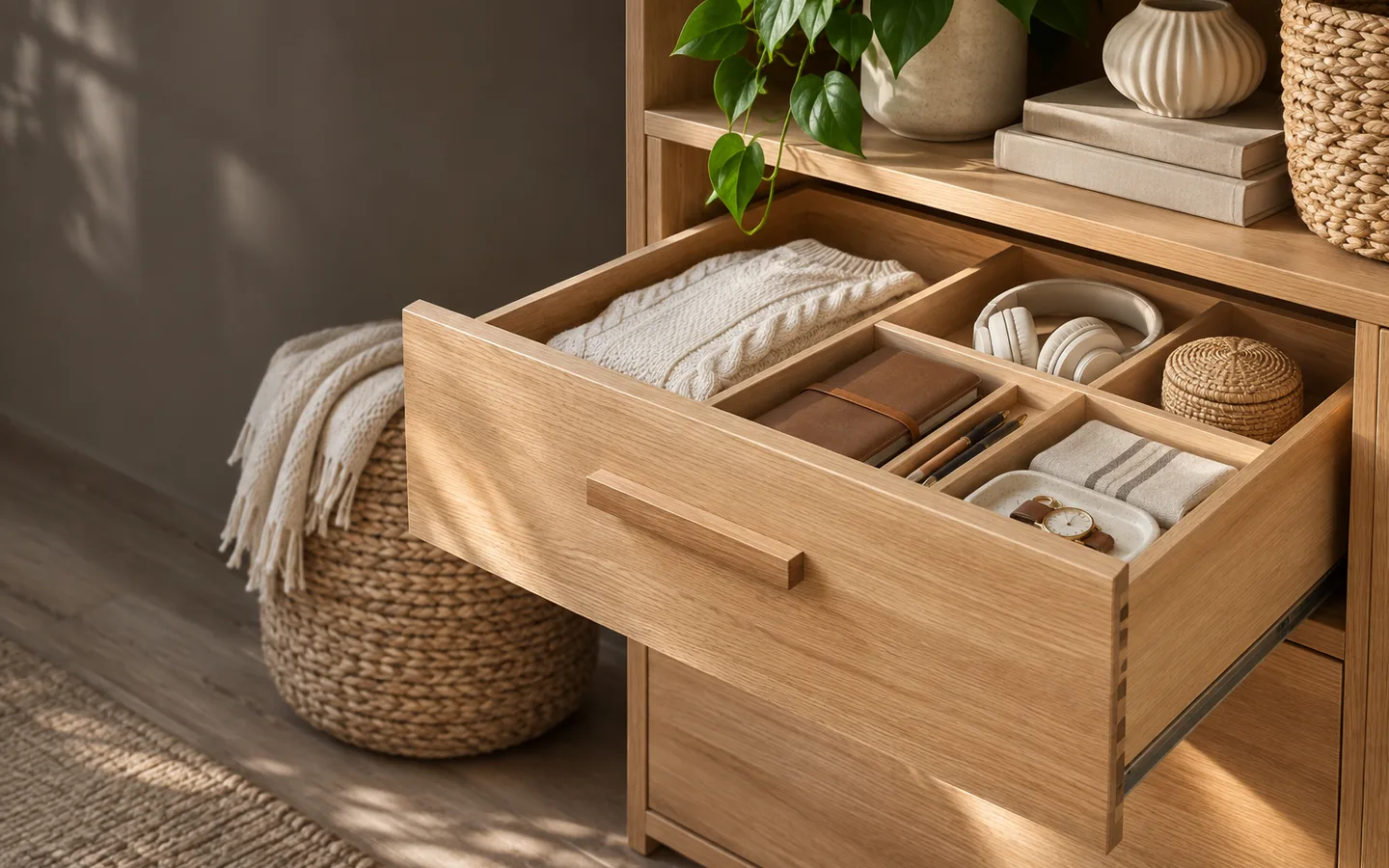
- Evaluate shelf span and deflection together: Review unsupported clear span, expected load (heavy books vs. folded knitwear), board thickness (18 mm vs. 25 mm), and back rebates or stiffeners.
- Check exact runner part numbers: Request the drawer runner model code, nominal length, dynamic load rating (e.g., 30 kg, 40 kg, or 60 kg), and maximum drawer width guidelines.
- Clarify gross vs. net load capacity: Confirm whether published runner ratings include the weight of the wooden drawer box and front or reflect payload only.
- Document destination compliance: For cross-border or commercial procurement, state destination emission regulations and applicable test certificates directly on the purchase order.
Frequently Asked Questions
Can different core boards be combined within a single piece of furniture?
Yes—mixing cores by function is standard engineering practice. Designers routinely pair smooth MDF doors for painted finishes with high-screw-holding plywood or balanced melamine-faced cores for internal carcasses.
Why is PUR edge banding often recommended near sinks and bathrooms?
Reactive polyurethane (PUR) adhesive forms a chemical cross-linked bond that delivers much higher heat and moisture resistance—alongside a thinner glue line—than conventional EVA hot-melt glue.
Further reading
- How to Approve Wood Furniture Finishes Under Real Room Lighting
- Ergonomic Furniture Storage Planning: Clear Dimensions and Daily Flow